


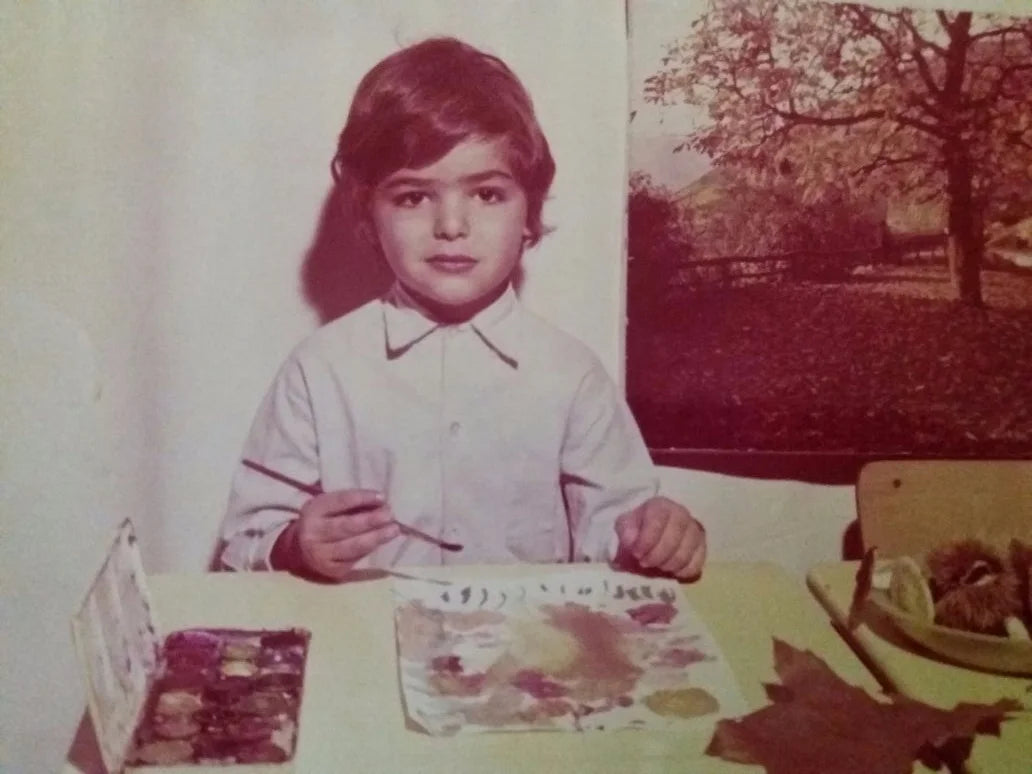
Yaakov Abergel
(1 products)
Born in France, in Toulouse, the Pink City, to ‘Hananiah Abergel and Esther Malka (née Berdah). The second of three children.
Until adolescence he lived in the countryside, in St Ferréol. At around the age of 12, his mother had him take violin lessons, which he followed for 2 years, but he decided to give up music to devote himself to drawing and painting. His father, a furniture and antiques dealer with a passion for Art, encouraged him to develop his taste for drawing. At the age of 12, he gave him an easel. This relationship that grew between them, that of an admirer of painters and a budding painter eager for advice and knowledge, continued throughout their lives.
At the age of 14, following his parents' divorce, he went to live with his mother and his two sisters in Toulouse. During this period he discovered comics, to which he would devote himself constantly until the age of 22. During his years in Toulouse he searched a great deal for his path, and in addition to a passion for photography and cinema, he began to take an interest in painting. After starting science studies, he finally obtained an arts baccalaureate, which led him to enroll at the School of Architecture, where he studied for 2 years. Before taking his exams to enter the third year, he decided to drop out and go to study at the St Luc school in Brussels, at its comics school. He studied there for 2 years. During this period he discovered contemporary Art and contemporary Artists and decided to give up comics to devote himself, he too, to contemporary Art.
He went to live in Italy, in Florence, in order to enroll in a painting school. When he enrolled, the director of the school, on seeing his work, remarked that he would be wasting his time continuing his studies and that the time had come to launch himself into life. He followed this advice and began a solitary path. After a year in Florence, he left the “Dolce Vita” to return to Toulouse, where he sat the Beaux-Arts entrance exam and passed, but he stayed only a few months at the Beaux-Arts, which he eventually left to devote himself to painting on his own. During his brief time at the Beaux-Arts in Toulouse, he met Annie Merle, who saw his work and chose him among the Artists to whom she devoted a book she would publish, entitled: “les peintres de l'école toulousaine”.
Until the age of 27, he never stopped working, painting and drawing, without ever managing to become part of an artistic milieu, whether in the world of galleries or among painters. Although he did not manage to exhibit his works, he continued his research. At 27, he decided to really earn a living. His parents, who worked in furniture sales, helped him become a salesman. He first worked in his father's shop, then his mother took him with her to teach him the trade. After a difficult start, he acquired a solid grounding that allowed him to go and live and work on his own in a shop in Paris. He worked there for 3 years. During this period he continued to draw, most of the time on the notepads used for sales. He painted a few pictures and made many drawings of the streets of Paris on his days off.
His older sister, who had by then become religious, sent him books on the deeper part of the Torah, on Chabad Hasidism and on the Lubavitcher Rebbe.
During the holidays he took a trip to Tahiti and Bora Bora. This trip would be decisive in his life, because it reawakened his desire to paint and create, to the point that after this trip he decided to resign from his sales job to devote himself to painting. He then traveled to Montreal, Canada, to visit his younger sister, who had been living there for some time. There he met Haim Sherff. This Israeli religious painter living in Montreal made him aware of the importance of being attached to his roots, and recommended that he become more religious by studying the Torah. Indeed, in his view, Art cannot be separated from the divine spirit expressed in the Torah. Yaakov took these recommendations to heart and, alongside his work as an Artist, began a religious path under the influence of the Master of Chabad Hasidism: the Lubavitcher Rebbe.
His new habits naturally led him to pray every morning at the synagogue on Rue Pallaprat, where Chief Rabbi Eliahou Haik also prays, and on Shabbat at the synagogue of the Rebbe's emissary in Toulouse: Rav Yossef-Itz’hak Matusof, who was the first to introduce him to the Rebbe and the Hasidic world. It was during this period that he discovered the book of the Tanya with Rav Gabriel Sebagh. He also studied Chabad ‘Hassidouth with Rav Israël Zerdoun.
He moved back to Toulouse. His mother met Dany Simon, the owner of an Art gallery, who organized a first exhibition for him, bringing together works inspired by the religious world.
It was at this time that he met Liba, through David and Edith Hagège, friends of his older sister, and he married her on June 22, 1997 in Lyon. A year after their wedding, the couple decided to join Yaakov's sister and her husband Samuel Marquès, who had been living in Israel for a year, and settled in Jerusalem.
He spent less and less time painting and drawing because he devoted himself to the study of the Torah, first at the Yeshiva of Rav ‘Haï Barkats and then, above all, at the Kollel of Rav Shimon Elitouv under the direction of Rav Avraham Kot. He spent 4 years at the Kollel and received rabbinical ordination from Rav Itz’hak Yéhoudah Yérouslavski. It was during this period that he met a person who would be decisive in his life, Rav Ytz’hak-Tsvi Eizenbakh, with whom he would study ‘Hassidouth for many years, and in particular the book of the Tanya. He attended many ‘Hassidouth classes, including classes given by Rav Aaron-Mordé’hi Zilberstraum, Rav Chmouel Weinfeld, Rav Chnéor-Zalman Gopin, Rav Avraham-Baroukh Pevzner and Rav Moché Weiner. Above all, he became attached to Rav Yossef-Itz’hak Offen, whose classes he attends to this day.
His artistic taste would quite naturally lead him to study Sofrouth in Bneï Brak with Rav Gerschtenkorn, who had been recommended to him by Rav Moché Landau. He received the Smi’ha of Sofer from Rav Yérouslavski, which has allowed him to practise the profession of Sofer to this day, writing in the Ktav of the Admour Hazaken.
He also obtained a Smi’ha of Cho’heth from Rav Shimon Elitouv, but apart from the Kapparoth he performs with his friend from the Kollel, Rav Yaakov Cho’hat, he would not practise this profession.
In 2000, his daughter ‘Haya-Mouchka was born in Jerusalem on the day of Purim Katan.
He changed Kollel and began studying dayanouth at the ‘Ariel’ Kollel, which he continues to this day, with Rav Moché Pinder. He devoted himself more and more to painting and painted many portraits of the Masters of Chabad. His creative work became increasingly diverse, and he began a series of seascapes on wooden pallets.
Alongside his studies and his artistic work, he devotes a great deal of time to writing works based on the teachings of the Masters of Chabad and of the Rebbe, and in particular on the essence of the soul. This subject would never leave him. He has thus published 3 books.
In 2009, his two sons were born on the day of Lag Ba Omer.
He is continuing to write a novel begun a few years ago that brings together travel memories (in particular the trip to Bora Bora) and reflections on Teshuvah. His work is entitled “des couleurs dans les veines” and reveals his passion for Art.
His sister organized an exhibition of his paintings in Raanana at the “Merkaz Giron” gallery. This gave him the opportunity to present, in large paintings, a small overview of his entire body of work, based essentially on the Hasidic world.
He then met Yaakov Benhaim and Moché Krieger of the magazine Météor LeMag, who made a video about it on that occasion. This meeting marked the beginning of a collaboration that would give rise to videos of Torah and ‘Hassidouth classes.
Spreading the sources of ‘Hassidouth is at the heart of his concerns, and while continuing his studies he gives many classes around him. His artistic activity is intensifying, and countless drawings are being added to his paintings.
His friend Nissim Belma put him in touch with his brother Elie, with whom he designed a website whose aim is to make his artistic work known and to spread the Sources of ‘Hassidouth outward.
Since his exhibition in Raanana, he has made a habit of writing excerpts from the Lubavitcher Rebbe's Hasidic discourses on his canvases. Mixing words with images in this way, the painter at last seems able to express his love for painting and for writing, which he unites on his canvases.
“You no doubt know that the skill of a painter consists in setting aside the external appearance of an object, in forgetting its outline, in order to penetrate it, to grasp its deeper aspect and its essence, so as to express it on the canvas. In this way, whoever contemplates it will perceive what he had not noticed before, when the inner part was hidden by incidental elements.”
The Lubavitcher Rebbe
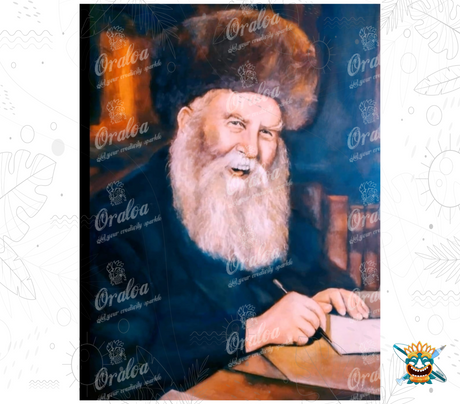
Oraloa offers 1 kit officially licensed by Yaakov Abergel.
Frequently asked questions
Frequently asked questions
Are the Yaakov Abergel kits official?
Yes. They are kits officially licensed by Yaakov Abergel, sold by Oraloa.
Which crafts are available with Yaakov Abergel?
Yaakov Abergel kits are available as: Diamond Painting.
How many Yaakov Abergel designs does Oraloa offer?
1 design at the moment.
- Featured
- Most relevant
- Best selling
- Alphabetically, A-Z
- Alphabetically, Z-A
- Price, low to high
- Price, high to low
- Date, old to new
- Date, new to old
- Sold out

© Yaacov Abergel
★★★★★★★★★★5.0 · 7 reviews5500 €Unit price /Unavailable

Born in France, in Toulouse, the Pink City, to ‘Hananiah Abergel and Esther Malka (née Berdah). The second of three children.
Until adolescence he lived in the countryside, in St Ferréol. At around the age of 12, his mother had him take violin lessons, which he followed for 2 years, but he decided to give up music to devote himself to drawing and painting. His father, a furniture and antiques dealer with a passion for Art, encouraged him to develop his taste for drawing. At the age of 12, he gave him an easel. This relationship that grew between them, that of an admirer of painters and a budding painter eager for advice and knowledge, continued throughout their lives.
At the age of 14, following his parents' divorce, he went to live with his mother and his two sisters in Toulouse. During this period he discovered comics, to which he would devote himself constantly until the age of 22. During his years in Toulouse he searched a great deal for his path, and in addition to a passion for photography and cinema, he began to take an interest in painting. After starting science studies, he finally obtained an arts baccalaureate, which led him to enroll at the School of Architecture, where he studied for 2 years. Before taking his exams to enter the third year, he decided to drop out and go to study at the St Luc school in Brussels, at its comics school. He studied there for 2 years. During this period he discovered contemporary Art and contemporary Artists and decided to give up comics to devote himself, he too, to contemporary Art.
He went to live in Italy, in Florence, in order to enroll in a painting school. When he enrolled, the director of the school, on seeing his work, remarked that he would be wasting his time continuing his studies and that the time had come to launch himself into life. He followed this advice and began a solitary path. After a year in Florence, he left the “Dolce Vita” to return to Toulouse, where he sat the Beaux-Arts entrance exam and passed, but he stayed only a few months at the Beaux-Arts, which he eventually left to devote himself to painting on his own. During his brief time at the Beaux-Arts in Toulouse, he met Annie Merle, who saw his work and chose him among the Artists to whom she devoted a book she would publish, entitled: “les peintres de l'école toulousaine”.
Until the age of 27, he never stopped working, painting and drawing, without ever managing to become part of an artistic milieu, whether in the world of galleries or among painters. Although he did not manage to exhibit his works, he continued his research. At 27, he decided to really earn a living. His parents, who worked in furniture sales, helped him become a salesman. He first worked in his father's shop, then his mother took him with her to teach him the trade. After a difficult start, he acquired a solid grounding that allowed him to go and live and work on his own in a shop in Paris. He worked there for 3 years. During this period he continued to draw, most of the time on the notepads used for sales. He painted a few pictures and made many drawings of the streets of Paris on his days off.
His older sister, who had by then become religious, sent him books on the deeper part of the Torah, on Chabad Hasidism and on the Lubavitcher Rebbe.
During the holidays he took a trip to Tahiti and Bora Bora. This trip would be decisive in his life, because it reawakened his desire to paint and create, to the point that after this trip he decided to resign from his sales job to devote himself to painting. He then traveled to Montreal, Canada, to visit his younger sister, who had been living there for some time. There he met Haim Sherff. This Israeli religious painter living in Montreal made him aware of the importance of being attached to his roots, and recommended that he become more religious by studying the Torah. Indeed, in his view, Art cannot be separated from the divine spirit expressed in the Torah. Yaakov took these recommendations to heart and, alongside his work as an Artist, began a religious path under the influence of the Master of Chabad Hasidism: the Lubavitcher Rebbe.
His new habits naturally led him to pray every morning at the synagogue on Rue Pallaprat, where Chief Rabbi Eliahou Haik also prays, and on Shabbat at the synagogue of the Rebbe's emissary in Toulouse: Rav Yossef-Itz’hak Matusof, who was the first to introduce him to the Rebbe and the Hasidic world. It was during this period that he discovered the book of the Tanya with Rav Gabriel Sebagh. He also studied Chabad ‘Hassidouth with Rav Israël Zerdoun.
He moved back to Toulouse. His mother met Dany Simon, the owner of an Art gallery, who organized a first exhibition for him, bringing together works inspired by the religious world.
It was at this time that he met Liba, through David and Edith Hagège, friends of his older sister, and he married her on June 22, 1997 in Lyon. A year after their wedding, the couple decided to join Yaakov's sister and her husband Samuel Marquès, who had been living in Israel for a year, and settled in Jerusalem.
He spent less and less time painting and drawing because he devoted himself to the study of the Torah, first at the Yeshiva of Rav ‘Haï Barkats and then, above all, at the Kollel of Rav Shimon Elitouv under the direction of Rav Avraham Kot. He spent 4 years at the Kollel and received rabbinical ordination from Rav Itz’hak Yéhoudah Yérouslavski. It was during this period that he met a person who would be decisive in his life, Rav Ytz’hak-Tsvi Eizenbakh, with whom he would study ‘Hassidouth for many years, and in particular the book of the Tanya. He attended many ‘Hassidouth classes, including classes given by Rav Aaron-Mordé’hi Zilberstraum, Rav Chmouel Weinfeld, Rav Chnéor-Zalman Gopin, Rav Avraham-Baroukh Pevzner and Rav Moché Weiner. Above all, he became attached to Rav Yossef-Itz’hak Offen, whose classes he attends to this day.
His artistic taste would quite naturally lead him to study Sofrouth in Bneï Brak with Rav Gerschtenkorn, who had been recommended to him by Rav Moché Landau. He received the Smi’ha of Sofer from Rav Yérouslavski, which has allowed him to practise the profession of Sofer to this day, writing in the Ktav of the Admour Hazaken.
He also obtained a Smi’ha of Cho’heth from Rav Shimon Elitouv, but apart from the Kapparoth he performs with his friend from the Kollel, Rav Yaakov Cho’hat, he would not practise this profession.
In 2000, his daughter ‘Haya-Mouchka was born in Jerusalem on the day of Purim Katan.
He changed Kollel and began studying dayanouth at the ‘Ariel’ Kollel, which he continues to this day, with Rav Moché Pinder. He devoted himself more and more to painting and painted many portraits of the Masters of Chabad. His creative work became increasingly diverse, and he began a series of seascapes on wooden pallets.
Alongside his studies and his artistic work, he devotes a great deal of time to writing works based on the teachings of the Masters of Chabad and of the Rebbe, and in particular on the essence of the soul. This subject would never leave him. He has thus published 3 books.
In 2009, his two sons were born on the day of Lag Ba Omer.
He is continuing to write a novel begun a few years ago that brings together travel memories (in particular the trip to Bora Bora) and reflections on Teshuvah. His work is entitled “des couleurs dans les veines” and reveals his passion for Art.
His sister organized an exhibition of his paintings in Raanana at the “Merkaz Giron” gallery. This gave him the opportunity to present, in large paintings, a small overview of his entire body of work, based essentially on the Hasidic world.
He then met Yaakov Benhaim and Moché Krieger of the magazine Météor LeMag, who made a video about it on that occasion. This meeting marked the beginning of a collaboration that would give rise to videos of Torah and ‘Hassidouth classes.
Spreading the sources of ‘Hassidouth is at the heart of his concerns, and while continuing his studies he gives many classes around him. His artistic activity is intensifying, and countless drawings are being added to his paintings.
His friend Nissim Belma put him in touch with his brother Elie, with whom he designed a website whose aim is to make his artistic work known and to spread the Sources of ‘Hassidouth outward.
Since his exhibition in Raanana, he has made a habit of writing excerpts from the Lubavitcher Rebbe's Hasidic discourses on his canvases. Mixing words with images in this way, the painter at last seems able to express his love for painting and for writing, which he unites on his canvases.
“You no doubt know that the skill of a painter consists in setting aside the external appearance of an object, in forgetting its outline, in order to penetrate it, to grasp its deeper aspect and its essence, so as to express it on the canvas. In this way, whoever contemplates it will perceive what he had not noticed before, when the inner part was hidden by incidental elements.”


